FROM yeyeolade.wordpress.com
 I stumbled four times to make Alaroye a success story – Alao Adedayo
July 8, 2011
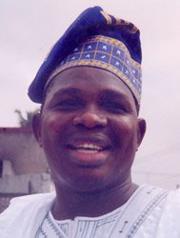
Musa Alao Adedayo, a.k.a Agbedegbeyo, is the Publisher/Chief Executive Officer, World Information Agents Limited, the publishing company of the popular Yoruba newspaper, ALAROYE. He spoke to BASHIR ADEFAKA about himself and how he stumbled four times to get it right with the vernacular paper that has today become a success story in the newspaper industry in Nigeria. Excerpt
How did you start out in life?
I am a Muslim but I am not a biased person because God Himself never loved a biased person. But those who know me from the beginning used to call me Alao Agbedegbeyo. When I talk of people who know me from the beginning, they are people from the 70s, early 80s and so on.
I came from Abeokuta to Lagos in 1980 doing Ewi (lyrics) artist. In those days as an Ewi person, you must be attached to a particular musician and I was with Dele Abiodun, who was like my master. Ewi was like side-attraction at a show and it would come on stage while the musician and his band members were taking a rest.
I had also participated in some dramas through the likes of Jide Kosoko, Ishola Ogunsola, (Dr. I. Show Pepper) and Adebayo Salami (Oga Bello). It was because of the Ewi that I used to present in those days that Jide Kosoko would always come to Dele Abiodun’s shows. He would say to me, “Alao, we are having an outing somewhere and I want you to perform your Ewi there,” and I would say no problem.
How did Ewi correlated with the broadcaster that you were?
By and large as God would have it, through that channel, as I have mentioned before, I became a broadcaster. Sometime in 1979, Radio Lagos started a programme called, Kebuyeri, which was mainly for the Awada Kerikeri group that was then run by Adebayo Salami popularly called Oga Bello. We went to a show at Ebute Metta and Adebayo Salami and his group members had also come to that show.
It was there he saw me and said, “Ah, Alao! Radio Lagos has just given us a programme and we want you to be in it” and I said no problem. We didn’t even discuss money because what was more important to us at that time was the job. That was how we started the programme and it became overwhelmingly popular turning me into a celebrity.
Behind that programme, a plan was going on by the management of Radio Lagos and the producer of the programme, Adebayo Tijani, communicated to me that management was talking about me and that was how I became a newscaster with Radio Lagos reading Yoruba news at that time.
I left Radio Lagos in 1981, which was a real year of politicking in the country. Then, Radio Nigeria Ikeja which was established within that time was located in Ikoyi and in fact when we were there, we were always abusing and calling them, “Agberekusu f’ohun Ikeja” that is, people who were on the Island claiming to be speaking from Ikeja (laughs). I eventually found myself at the Radio Nigeria Ikeja and later NTA but I did not stay long before I left.
When you left service, where did you go?
When we joined broadcasting, most of us did not get the job because of our educational qualifications and so, when I left the NTA, it was an opportunity for me to now go and improve myself, which then took me to the Nigerian Institute of Journalism (NIJ) and then the universities for my first and later second degrees.
How did Alaroye come into the show?
It was in May 1985 when I was 25 and while I was still working as a Yoruba newsreader with the NTA that I decided to try my hands in publishing, which brought about the Alaroye. Between May and October of 1985, I was only able to publish four editions of the tabloid that was meant to be weekly. I was doing it alone because I had no such money to hire people. It thus became a staggered publication because it was a one-man’s idea and as a result, no prospective partner was willing to support or invest in the business. It was also like that because Yoruba newspaper business at that time was seen as a barren land. So, naturally, it died.
Further effort was made at resuscitating the paper in 1990 but it couldn’t get to the vendors, though it was being published. It was to be launched that year so that some funds could be raised. On the day of the launching, a prominent member of the community who was a friend of both the chief launcher and chairman, Lai Balogun, died. So it was a wrong day for the Alaroye’s show as the whole community was thrown into mourning and no one remembered the launch.
In 1994 when I made the third attempt at the publication, I was convinced that Alaroye would one day emerge a success story because, for four weeks, I was able to publish the weekly paper consecutively and throughtout the period, it was well circulated and generally accepted.
And because I had acquired more knowledge about all it required to make a successful print media, Alaroye was able to stand and able to meet the standard of a newspaper. Yet, it couldn’t go far because I could not raise the required fund to keep it going. And for two years, it remained like that until July 2, 1996, when we were able to revisit it and tried our best to make it what it is today. That was the fourth attempt and it has now come to stay.
I thank God that today, Alaroye is seen not as a happenstance, but a planned revolution in the newspaper industry in Nigeria. And it is so because, no Yoruba newspaper has been so successful because most of the earlier issues, people have said, were translataion of English newspapers or repetition of news items already carried on radio and television.
Alaroye is original for its thorough analysis, research works and investigative journalism that many have appreciated as having put the newspaper on a very high pedestal. It informs, educates, entertains and analyses events as they unfold through the Yoruba culture. For this, it circulates in Nigeria, wherever Yoruba domicile, with the print run sometimes as high as 150,000 copies per week. I have the reason to really thank God today because, in Nigeria, particularly among the Yorubas, Alaroye is a language. It is the culture.
The Conference of Yoruba Leaders showcased by your newspaper, which debuted in 2002, hasn’t seemed to produce any result considering the fact that Yorubas are still intolerably disunited. What is the problem?
The problem we have in Yorubaland is the way we play our own politics. What Alaroye is trying to do is to serve as a bridge to bring all the leaders together. There is need for a connecting point, which will connect all Yoruba people with one another. We have very, very intelligent, well exposed and highly patriotic sons and daughters of Yorubaland. We cannot run away from the fact that we are Yorubas; we had been Yoruba people before Nigeria and we will remain Yoruba people within Nigeria.
Yes, political party differences are there but we should be able to know that there is difference between politics and governance. So, during election, you can abuse and criticize yourselves but once election is over, issue of governance becomes the central point while politicking is set aside for another election season. And if you are the governor, you should see yourself as the father of all, as the head of government and people should see the governor beyond his party but as the leader that all of us should relate well with as one of our own.
In the year 2002, I went to Papa Abraham Adesanya and I said to him, “E ma bawon se oselu. Ema bawon da si oro oselu. Asiwaju Yoruba ni ki’e je” (That Papa should not be part of politics other Yorubas played but that he should be okay with himself as Leader of the Yoruba Nation).
He asked me why. We talked a lot about it and he agreed with me. Not only that I went to discuss it with him, we made it a critical editorial issue, which some of the Afenifere members then responded to.

[
 Yeye Akilimali Funua Olade: You are commenting using your WordPress.com account. ( Log Out / Ch
Alaroye Newspaper IS SAVING YORUBA LANGUAGE From DESTRUCTION!-ALAO ADEDAYO FOUNDER TELLS HOW HE FINALLY SUCCEEDED IN PRODUCING A FLORISHING YORUBA NEWSPAPER ! –YORUBA IS DYING! —WHAT CAN YOU DO TO SAVE IT??-FROM VANGUARD NEWSPAPER((NIGERIA)
Alao Adedayo-Founder/savior of Yoruba Language
thru his GREAT newspaper Alaroye! Do Your own part and BUY it every
week, get your children to read it- FIGHT TO SAVE Yoruba Language. FROM
DYING!
July 8, 2011
Musa Alao Adedayo, a.k.a Agbedegbeyo, is the Publisher/Chief Executive Officer, World Information Agents Limited, the publishing company of the popular Yoruba newspaper, ALAROYE. He spoke to BASHIR ADEFAKA about himself and how he stumbled four times to get it right with the vernacular paper that has today become a success story in the newspaper industry in Nigeria. Excerpt
How did you start out in life?
I am a Muslim but I am not a biased person because God Himself never loved a biased person. But those who know me from the beginning used to call me Alao Agbedegbeyo. When I talk of people who know me from the beginning, they are people from the 70s, early 80s and so on.
I came from Abeokuta to Lagos in 1980 doing Ewi (lyrics) artist. In those days as an Ewi person, you must be attached to a particular musician and I was with Dele Abiodun, who was like my master. Ewi was like side-attraction at a show and it would come on stage while the musician and his band members were taking a rest.
I had also participated in some dramas through the likes of Jide Kosoko, Ishola Ogunsola, (Dr. I. Show Pepper) and Adebayo Salami (Oga Bello). It was because of the Ewi that I used to present in those days that Jide Kosoko would always come to Dele Abiodun’s shows. He would say to me, “Alao, we are having an outing somewhere and I want you to perform your Ewi there,” and I would say no problem.
How did Ewi correlated with the broadcaster that you were?
By and large as God would have it, through that channel, as I have mentioned before, I became a broadcaster. Sometime in 1979, Radio Lagos started a programme called, Kebuyeri, which was mainly for the Awada Kerikeri group that was then run by Adebayo Salami popularly called Oga Bello. We went to a show at Ebute Metta and Adebayo Salami and his group members had also come to that show.
It was there he saw me and said, “Ah, Alao! Radio Lagos has just given us a programme and we want you to be in it” and I said no problem. We didn’t even discuss money because what was more important to us at that time was the job. That was how we started the programme and it became overwhelmingly popular turning me into a celebrity.
Behind that programme, a plan was going on by the management of Radio Lagos and the producer of the programme, Adebayo Tijani, communicated to me that management was talking about me and that was how I became a newscaster with Radio Lagos reading Yoruba news at that time.
I left Radio Lagos in 1981, which was a real year of politicking in the country. Then, Radio Nigeria Ikeja which was established within that time was located in Ikoyi and in fact when we were there, we were always abusing and calling them, “Agberekusu f’ohun Ikeja” that is, people who were on the Island claiming to be speaking from Ikeja (laughs). I eventually found myself at the Radio Nigeria Ikeja and later NTA but I did not stay long before I left.
When you left service, where did you go?
When we joined broadcasting, most of us did not get the job because of our educational qualifications and so, when I left the NTA, it was an opportunity for me to now go and improve myself, which then took me to the Nigerian Institute of Journalism (NIJ) and then the universities for my first and later second degrees.
How did Alaroye come into the show?
It was in May 1985 when I was 25 and while I was still working as a Yoruba newsreader with the NTA that I decided to try my hands in publishing, which brought about the Alaroye. Between May and October of 1985, I was only able to publish four editions of the tabloid that was meant to be weekly. I was doing it alone because I had no such money to hire people. It thus became a staggered publication because it was a one-man’s idea and as a result, no prospective partner was willing to support or invest in the business. It was also like that because Yoruba newspaper business at that time was seen as a barren land. So, naturally, it died.
Further effort was made at resuscitating the paper in 1990 but it couldn’t get to the vendors, though it was being published. It was to be launched that year so that some funds could be raised. On the day of the launching, a prominent member of the community who was a friend of both the chief launcher and chairman, Lai Balogun, died. So it was a wrong day for the Alaroye’s show as the whole community was thrown into mourning and no one remembered the launch.
In 1994 when I made the third attempt at the publication, I was convinced that Alaroye would one day emerge a success story because, for four weeks, I was able to publish the weekly paper consecutively and throughtout the period, it was well circulated and generally accepted.
And because I had acquired more knowledge about all it required to make a successful print media, Alaroye was able to stand and able to meet the standard of a newspaper. Yet, it couldn’t go far because I could not raise the required fund to keep it going. And for two years, it remained like that until July 2, 1996, when we were able to revisit it and tried our best to make it what it is today. That was the fourth attempt and it has now come to stay.
I thank God that today, Alaroye is seen not as a happenstance, but a planned revolution in the newspaper industry in Nigeria. And it is so because, no Yoruba newspaper has been so successful because most of the earlier issues, people have said, were translataion of English newspapers or repetition of news items already carried on radio and television.
Alaroye is original for its thorough analysis, research works and investigative journalism that many have appreciated as having put the newspaper on a very high pedestal. It informs, educates, entertains and analyses events as they unfold through the Yoruba culture. For this, it circulates in Nigeria, wherever Yoruba domicile, with the print run sometimes as high as 150,000 copies per week. I have the reason to really thank God today because, in Nigeria, particularly among the Yorubas, Alaroye is a language. It is the culture.
The Conference of Yoruba Leaders showcased by your newspaper, which debuted in 2002, hasn’t seemed to produce any result considering the fact that Yorubas are still intolerably disunited. What is the problem?
The problem we have in Yorubaland is the way we play our own politics. What Alaroye is trying to do is to serve as a bridge to bring all the leaders together. There is need for a connecting point, which will connect all Yoruba people with one another. We have very, very intelligent, well exposed and highly patriotic sons and daughters of Yorubaland. We cannot run away from the fact that we are Yorubas; we had been Yoruba people before Nigeria and we will remain Yoruba people within Nigeria.
Yes, political party differences are there but we should be able to know that there is difference between politics and governance. So, during election, you can abuse and criticize yourselves but once election is over, issue of governance becomes the central point while politicking is set aside for another election season. And if you are the governor, you should see yourself as the father of all, as the head of government and people should see the governor beyond his party but as the leader that all of us should relate well with as one of our own.
In the year 2002, I went to Papa Abraham Adesanya and I said to him, “E ma bawon se oselu. Ema bawon da si oro oselu. Asiwaju Yoruba ni ki’e je” (That Papa should not be part of politics other Yorubas played but that he should be okay with himself as Leader of the Yoruba Nation).
He asked me why. We talked a lot about it and he agreed with me. Not only that I went to discuss it with him, we made it a critical editorial issue, which some of the Afenifere members then responded to.

[
Leave a Reply

 FROM
FROM