YORUBA! -TRANSLATE ARTICLES TO YORUBA HERE!


BAYO ADEBOWALE-A GREAT AFRICAN WRITER!!


BAYO ADEBOWALE-GREAT AFRICAN WRITER

Saturday, July 21, 2018

FIRST VILLAGE-COMMUNITY ANTHEM IN NIGERIA COMPOSED BY BAYO ADEBOWALE

FIRST VILLAGE-COMMUNITY ANTHEM IN NIGERIA COMPOSED BY BAYO ADEBOWALE
CLICK ON FOR VIDEO-https://twitter.com/YeyeOlade/status/1020655196601450496/video/1
FIRST VILLAGE -COMMUNITY ANTHEM IN NIGERIA

IGBO-ELERIN ANTHEM

YORUBA

Igbo- Elerin wa
Ile wa olokiki
K’Oluwa ko bukun wa
K’ani alafia

Osi o ni ta ‘wa
Awa l’ayo a sope
Idunnu ati ‘lera


Ko je ipin ti wa

K’a ni ‘losiwaju
Ife ati ‘sokan
K’a ni ‘tesiwaju
L’okunrin l’obinrin
Imole wa si ma tan
Gege bi ‘rawo sanmo

Igbo-Elerin wa
Ile wa olokiki
K’Oluwa ko bukun wa
K’ani alafia

FIRST VILLAGE-COMMUNITY ANTHEM IN NIGERIA
IGBO-ELERIN ANTHEM

ENGLISH TRANSLATION

Igbo-Elerin land
Our land of mark and fame
Blessing of good Lord with us
May we all be at peace

We ‘ ll rise above penury
We are thankful, we praise thee
Happiness, abundant health
Shall become our portion

Let’s have steady progress
Unity and regard
Let’s have advancement
For all men and women
Our fame is going to spread
Like bright stars in the sky

Igbo-Elerin land
Our land of mark and fame
Blessing of good Lord with us
May we all be at peace

Press Release: BAYO ADEBOWALE COMPOSES THE FIRST RURAL-COMMUNITY ANTHEM IN NIGERIA

History was made in an Ibadan District in Lagelu Local Government Area of Oyo State, Nigeria on Saturday 3rd March 2018, when the community people’s anthem ( Igbo-Elerin Wa- Ile Wa Olokiki) was launched, with thousands of enthusiastic rural community people, from about 300 villages and hamlets in attendance. The anthem, which was composed at African Heritage Research Library and Cultural Centre, Adeyipo and rendered into song by poet and novelist Bayo Adebowale, turned out to be the First Official Village Community Anthem in Nigeria.

The anthem highlights the fame and popularity of this Ibadan District, and admonishes the community people of the area to always strive to attain peace, unity and advancement for their beloved fatherland, praying that happiness and sound health would be their portion as they continue to shine like bright stars in the sky.

The anthem was presented by the students of Igbo-Elerin Grammar School, and the pupils of Unity School, Adeyipo, with Abraham Olukunmi Agboola conducting it before the audience (of eminent personalities, including His Eminence, DrSunday Ola Makinde, Prelate Emeritus Methodist Church of Nigeria; Professor (Chief) Ezekiel Olukayode Idowu; Professor Harry Taiwo Ladapo; and all 21 Baale’s of Igbo-Elerin land) at Igbo-Elerin Grammar School Ground on 3rd March 2018.

Bayo Adebowale (PhD) (Associate Professor of Creative Writing in English) who composed the anthem, is

a poet, novelist, short story writer,critic, literary scholar, librarian, community leader, and the Director/Founder, African Heritage Research Library and Cultural Centre, (AHRLC) Adeyipo Village, Ibadan, Nigeria.

(From: Gbemisola Edun, Secretary, AHRLC)

FIRST RURAL-COMMUNITY VILLAGE ANTHEM COMPOSED BY BAYO ADEBOWALE


THE FIRST RURAL-COMMUNITY ANTHEM IN NIGERIA COMPOSED BY BAYO ADEBOWALE


IGBO-ELERIN ANTHEM

YORUBA

Igbo- Elerin wa
Ile wa olokiki
K’Oluwa ko bukun wa
K’ani alafia

Osi o ni ta ‘wa
Awa l’ayo a sope
Idunnu ati ‘lera


Ko je ipin ti wa

K’a ni ‘losiwaju
Ife ati ‘sokan
K’a ni ‘tesiwaju
L’okunrin l’obinrin
Imole wa si ma tan
Gege bi ‘rawo sanmo

Igbo-Elerin wa
Ile wa olokiki
K’Oluwa ko bukun wa
K’ani alafia

FIRST VILLAGE-COMMUNITY ANTHEM IN NIGERIA
IGBO-ELERIN ANTHEM

ENGLISH TRANSLATION

Igbo-Elerin land
Our land of mark and fame
Blessing of good Lord with us
May we all be at peace

We ‘ ll rise above penury
We are thankful, we praise thee
Happiness, abundant health
Shall become our portion

Let’s have steady progress
Unity and regard
Let’s have advancement
For all men and women
Our fame is going to spread
Like bright stars in the sky

Igbo-Elerin land
Our land of mark and fame
Blessing of good Lord with us
May we all be at peace

Press Release: BAYO ADEBOWALE COMPOSES THE FIRST RURAL-COMMUNITY ANTHEM IN NIGERIA

History was made in an Ibadan District in Lagelu Local Government Area of Oyo State, Nigeria on Saturday 3rd March 2018, when the community people’s anthem ( Igbo-Elerin Wa- Ile Wa Olokiki) was launched, with thousands of enthusiastic rural community people, from about 300 villages and hamlets in attendance. The anthem, which was composed at African Heritage Research Library and Cultural Centre, Adeyipo and rendered into song by poet and novelist Bayo Adebowale, turned out to be the First Official Village Community Anthem in Nigeria.

The anthem highlights the fame and popularity of this Ibadan District, and admonishes the community people of the area to always strive to attain peace, unity and advancement for their beloved fatherland, praying that happiness and sound health would be their portion as they continue to shine like bright stars in the sky.

The anthem was presented by the students of Igbo-Elerin Grammar School, and the pupils of Unity School, Adeyipo, with Abraham Olukunmi Agboola conducting it before the audience (of eminent personalities, including His Eminence, DrSunday Ola Makinde, Prelate Emeritus Methodist Church of Nigeria; Professor (Chief) Ezekiel Olukayode Idowu; Professor Harry Taiwo Ladapo; and all 21 Baale’s of Igbo-Elerin land) at Igbo-Elerin Grammar School Ground on 3rd March 2018.

Bayo Adebowale (PhD) (Associate Professor of Creative Writing in English) who composed the anthem, is

a poet, novelist, short story writer,critic, literary scholar, librarian, community leader, and the Director/Founder, African Heritage Research Library and Cultural Centre, (AHRLC) Adeyipo Village, Ibadan, Nigeria.

(From: Gbemisola Edun, Secretary, AHRLC)

Monday, September 25, 2017

Wednesday, December 21, 2016

BAYO ADEBOWALE'S LATEST POWERFUL AFRICAN POETRY BOOK-"ORIKI"-TRADITIONAL POEMS(CELEBRATING HEROES AND HEROINES OF AFRICLAND)-GET YOUR COPY KIAKIA(QUICKLY!!!)


PUBLICATION OF A NEW POETRY BOOK: 
                  ORIKI
        TRADITIONAL POEMS
(CELEBRATING HEROES AND HEROINES OF AFRICLAND)
                   BY
       BAYO ADEBOWALE
A BOOK CRAFTED WITH ARTISTIC DEXTERITY!!!
PUBLISHED BY BOOKSMITH,IBADAN,NIGERIA
         2016
     120 PAGES


PRICE OF THIS POWERFUL BOOK!

N 500 NAIRA
POSTAGE N100

FOREIGN
$2.00
POSTAGE
$1.00 (AIR MAIL)

MAKE CHECK-MONEY ORDER OUT TO:
BAYO ADEBOWALE

Monday, July 28, 2014

AFRICAN WRITER WOLE SOYINKA'S 3RD WIFE TELLS THEIR LOVE STORY!-FROM CITY PEOPLE MAGAZINE,NIGERIA

FROM CITY PEOPLE MAGAZINE


“How I Met & Fell In Love With Wole Soyinka” – Wife, Folake Reveals

Not many people know who Prof. Wole Soyinka’s wife is. Not many know their love story. A few weeks ago, Folake Soyinka opened up to The News magazine on her love story, revealing how they first met at University of Ife (now Obafemi Awolowo University) whilst she was a student. Excerpts:
How would you describe Prof Wole Soyinka as a husband, father and a husband being?
He is the best human being you can think of. He is very concerned about other people and their suffering even to his own detriment sometimes. H e is just a warm person. Looking at him, you may not know this, but that is who he is. He is someone you would want as a friend. He is very loyal. He is the best friend you can ask for. On National Public Radio –NPR – I listen every morning to a popular programme called Story Corp. One day, they featured a couple that had been married for 70 years, being interviewed by their great grandchildren. They asked the couple why their marriage had lasted so long and both replied that they never fell out of love at the same time.
When one was tired the other was still holding on and I said to myself, “that just describes my marriage.” When he was tired I held on and when I was tired he held on. And now, none of us is tired. We’re still holding on.As a father, I think his children can answer that better but I can tell you that it is difficult to be his child because of his nature. He is not home very often. For a wife, you pretty much have an inkling into what you are getting when you marry someone like him, but a child does not. It’s something you’re into. He recognizes it and alludes to it in is dedication in his book, You Must Set Forth at Dawn” where he wrote. “To my stoically resigned children. “No one likes to share those they love, but they have to share their father with the world. It is difficult for them all.
With my own boys, right from the beginning, I shared with them an advice my sister-in-law, Dr. Folabo Soyinka-Ajayi, gave me when I was newly married. She said her brother “loved their mother a lot but she was never able to own him, not that she didn’t try. She said no one can own him, not is siblings, his wife or his children, he is a world citizen.” I explained that to my boys as soon as they began to notice their father’s absence when other kids had theirs. It is something you understand more as you grow older, even then, it is difficult to accept. I think they grew to understand this, and they feel loved and they got used to him, so that helps. I also think that he relates better with older children. Now, I watch him sit and talk with some of his children who are all now older, and marvel at how the relationships have transformed. It is nice to see. That is him as a father. Professor Soyinka is a great provider as well; you are not going to get the Lamborghini or Bentley Continental GT, but you will get your school fees and it won’t be late. He is very responsible.
Do you sometimes feel that you are in competition with quite a number of other women who want is attention?
No, right from the beginning, I knew he liked me as a person. I am not talking about love now, even though, I knew he loved me. We are great friends and we laugh together a lot. I knew that he wouldn’t deliberately hurt or humiliate me. I also know that there is nothing you can do to stop two consenting adults. Women are always around under all kinds of guises but I have never felt in competition with anyone. Sometimes it intrudes on our lives, but no competition.
How did your love affair start?
As I said, I knew he always liked me from when I was in the University of Ife but I was young and he was so accomplished, so I was kind of worried. After I left Ife and went to do my National Service –NYSC in Kaduna, Dr. Biodun Jeyifo came to visit me and said Kongi had been looking for me. After the service year, Dr. Yemi Ogunbiyi who was at The Guardian got me a job there and one day, he stopped by. The rest of the story is in the public domain with all kinds of unbelievable variations. You also know it. Everybody was part of that story.
What was the period of courtship like?
It was interesting. I was working at The Guardian at that time, he was slowly moving out of Ife. He was exploring where to build a house between Ibadan and Abeokuta. In the end, he chose Abeokuta. Prior to building our house, he lived in Idi-Aba area of Abeokuta. So, for most of our courtship, we lived there and we continued living there after we were married. I worked Monday through Friday and most weekends when I wasn’t working I was in Abeokuta. He would sometimes visit me in Lagos and we spent time together there. Oftentimes, he was busy as I was. Mr. Lade Bonuola, the editor of The Guardian then kept all of us, his reporters, one our toes. We saw each other often but we couldn’t do everyday things that people do because of who he is, but it was nice, very nice. I look back fondly to those days.
When he eventually proposed that he wanted to marry you, was there any objection from anywhere?
I think there were objections from everywhere except from my sisters and brother who were happy if I was. I also had the support of his siblings here. My parents along with most of my relatives objected, not because of anything, they just felt he was too famous and too accomplished. They worried about that. But within a few months after we were married, my parents had changed their minds and they loved him until they both passed away. His close friends didn’t have a problem with it but almost everyone had an opinion. Then came the Nobel Prize in 1986 and that derailed everything for a couple of years. More than a quarter of a century later, those opinions didn’t count, we’re still trudging along. I have enjoyed tremendous love because of him.
Apart from wines which we all know he loves drinking, what re his favourite foods?
He is not a big eater. Even when he eats, it is always in small quantities. The boys always want to go out to each with him because they usually end up eating his food. He likes salami, pasta, moin-moin cooked in leaves especially the stray part that hides between the folded leaves. He doesn’t eat much and I guess that is why he is so slim.
I understand he is a good cook.
He cooks and he is quite good at it. He even cooked about two days ago. When the boys were really little, one day in California, he called us all to the kitchen and said he wanted to have a family meeting. They were so young I don’t even think they had any concept of what a family meeting was. He lined all three according to their heights and asked me to sit. He said he has something to tell us and he was only going to say it once. He whipped out some cooking utensils, moved them around noisily inside the pot, threw some up, caught them, performed a few tricks and then told us to listen up. He said there were only three people in the world that can cook pasta like he does: one is dead, the other lives in Sicily, Italy, and he is the third one and he is going to cook something the likes of which we had never eaten. He cooked pasta that day and we truly enjoyed it. True dramatist! Now when all else fails, he cooks pasta.
What are the things you notice when he is writing or reading seriously?
We leave him alone. We don’t intrude. I don’t know of many people who love what they do for a living like he does. He doesn’t like the administrative part of it like replying endless emails, but he loves writing. I say to my kids how lucky he is to have found something he loves and then do it for a living. He doesn’t bring in as much money as most people think, but then, that is not his motivation for writing. Even when he arrives home from a different time zone, he would wake up in the morning, go into his study, probably at about seven in the morning and if he can’t sleep, he would go in at 3am and work until mid-day non-stop. So, when the kids are going to school in the morning, they don’t even bother to go into the study too say good morning, they just leave him alone.
When he comes out, does he sometimes share the joy and pleasure of his creation with you?
No, he doesn’t discuss what he is working on with anybody. Sometimes, when he is done with a manuscript and he is sending it to the publishers, that’s when I find out what he’s been working on.
Do you sometimes help him edit?
No, I do not interfere. When he brings cover designs for the book, he may ask me which I prefer and he may or may not accept my choice. That’s the extent of my involvement in his creative work.
When you turned 50 two years ago, he danced with you. Does he love to dance? Between both of you who is a better dancer?
Of course, I am a better dancer and I dance more often. I am sure if you ask him, he would say he is a better dancer and that would not be true. He doesn’t dance often. Sometimes, when we are with Uncle Tunji Oyelana of the Benders, he would go on the microphone and they would start signing and a few hours later, they would be arguing about how a song should go and its interpretation. He sings more than he dances. Recently both of us went to see a play and when we got home he started to mimic the dancers, it was hilarious because it was break dancing.
The late Chief Bola Ige once told me that Wole Soyinka may look stone-faced in public, but he can be incredible moved to tears by the pain of others. How true is that?
It is true what Chief Bola Ige said. He is moved by the sufferings of others even to the extent that it affects us at home. You know for sure when something is bothering him and it bothers him more when he cannot do anything about it. You have no idea how the kidnap of the Chibok girls has affected our lives. It is constantly on his mind. Death also bothers him. Recently, when one of is daughters, Yetade, passed away, he wept. The boys had never seen him cry but this time he was weeping uncontrollably. It was shortly after Christmas, so we were all home when the news came. I think that incident rocked him. They say time heals, but I don’t know how time heals the death of a beloved child.
You both have three sons together, how are they doing?
They are all doing very well. It’s just the two of us at home now that the children have all gone in different directions. The first two have been away for a while. One graduated from Stanford University and is now in medical school, the other went to Colgate University and would like to go to Law School and my last is headed to Harvard University where he will be studying Computer Science and Engineering. Fortunately for us, each of them got a scholarship, so we’ve been truly blessed.

Tuesday, August 14, 2012

BAYO ADEBOWALE'S LATEST BOOK IS OUT!-IT PUTS AFRICAN POETRY IN A NEW CATAGORY WITH ITS BRILLIANT AFRICAN IMAGERY! - GET YOUR COPY NOW!

BAYO  ADEBOWALE’S  AFRICAN MELODY
SINGS FULL-THROATED POETIC SONGS FOR AFRICA
Bayo Adebowale’s newly- published book, AFRICAN MELODY, (A Poetic Exposition of the African Essence) combines sweet melody with harsh melody, melody of expectation with melody of hope, for the African Continent. The 144 page book, containing a total of 61 poems, takes readers on a poetic excursion through the socio-cultural history of a Continent at the focus of global attention.
 
Nature and landscape in the book receive close scrutiny, as much as a number of selected political and historical events in the life of Africans on the Continent, and Africans in the Diaspora. (e.g slave trade, colonialism, coup d’etat, poverty, class distinction famine, racism, genocide, etc.)The poet adulates the achievements of the heroes and heroines of the land, while despots who smear the Continent’s beautiful garment with mud, receive castigation and several knocks on the head.
 
Sweet melody reverberates right from the beginning of the book, as readers encounter ‘motionless crocodiles basking under the blazing afternoon sun, at the magnificent swimming pool of Limpopo’ (p.12); ‘termites milling protectively round their Queen in the palatial fortress, inside the kingdom of the giant anthill’ (p.86); ‘photographs of brown-grass savannah teeming with spotted long-necked giraffes  journeying on the express road of the mind in the open horizon of Pategi’(p.19) ; ’ the receding evening sun sitting down on the busy bay of Lake Chad, immobile like a fat market woman transacting business.’(p.6)
 
Harsh melody, in one other section of the book, exposes Africa as ‘an ailing giant walking with the limbs of a stegomyia and nursing a pulsating numbness in the region of his left leg’(p.53). The ancestral land here has become ‘an elephant crippled by a snare; an antelope caught in a trap; an impala extricating from a tightening noose; a puff adder with his stomach swollen by an undigested rodent; and an earthworm dancing the dance of death in a lake of salt.’(p.59-60)
 
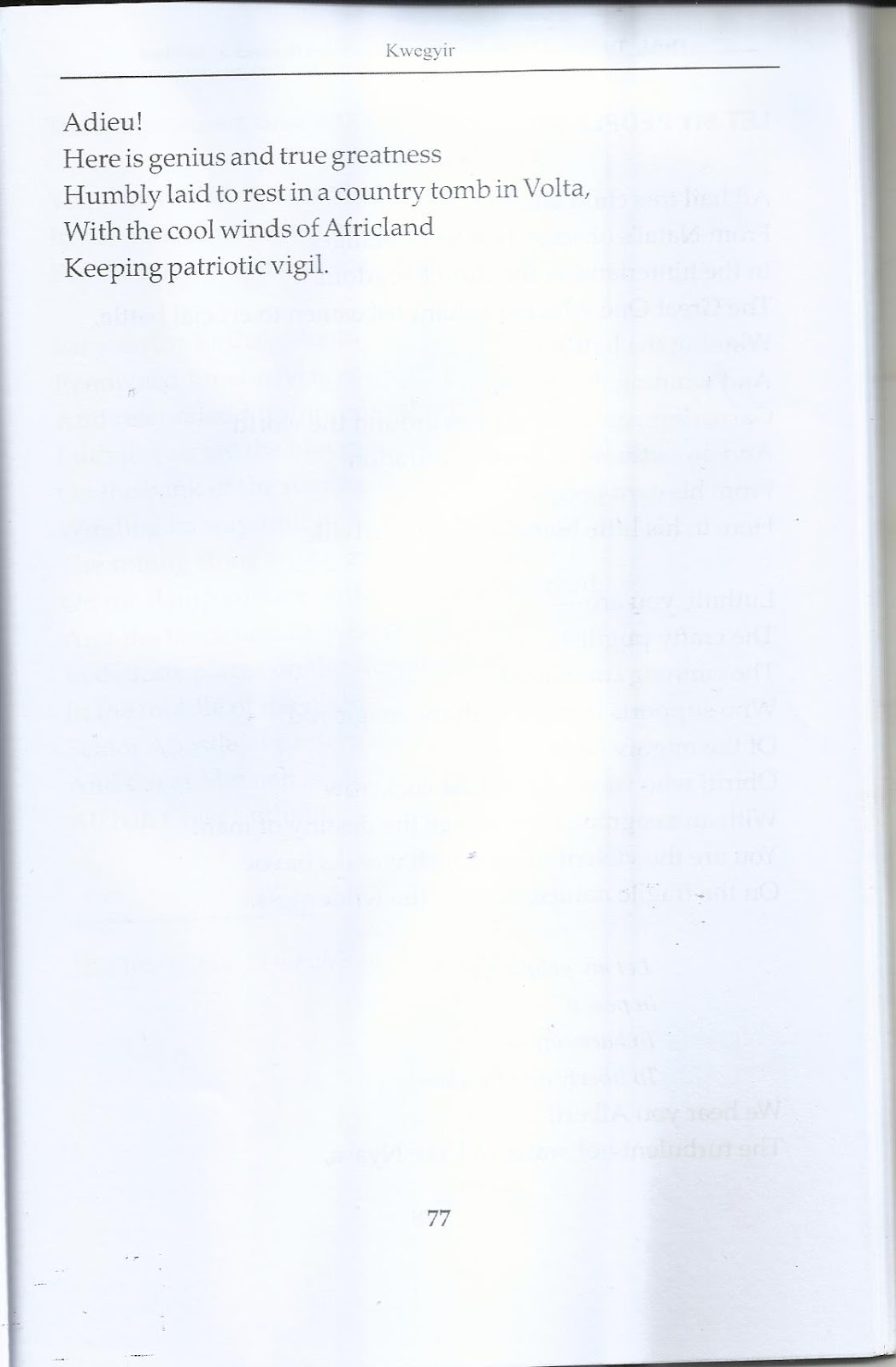
Melody of hope resounds in the book with the arrival of notable icons – African role models like Shaka –‘ the black pugilist of the unconquered land of the rugged Zulu nation’(p.14); Kwegyir –‘ the amiable Goldcoast whiz kid who at school chanted multiplication table with ease and acted Daniel in the Lion’s Den with dexterity’(p.21); Makeba – ‘the cool evening nightingale perching on the African bamboo, dishing out symphonies of pleasant solo tunes in mezzo-soprano octave to a listening universe’(p.84); Luthuli – ‘the blooming banana rhizome on the bank of the roaring River Orange’ (p.10); Ali –‘ the buzzing bee with a deadly sting, the graceful butterfly floating in the openness of the blue sky’(p.110); and Mandela, ‘who trod, unscathed, the narrow freedom road, strewn with pricks and pains, thistles and bristles.’(p.98) and Barrack Obama – ‘the long African broom, sweeping the New World horizon incredibly clean and penny – bright… the arrow head of mighty Luo spear shooting staright to target’ (p.124).
 
In Bayo Adebowale’s AFRICAN MELODY, it is music all the way; Music ‘touching the incore of our heart; jerking us to alertness; and stimulating in us, wonder and incredulity’… Music,’ soft as the murmur of the dove at dawn, pervading our days with delight, in cadences of joyful bubbles; and music, harsh as the monotonous tap on the blacksmith’s anvil permeating our nights with grief, in sequences of sad gurgles.’ (p.23)
 
The inclusion of a Classified Index in this brand new book is unique, so also is the full-colour display of imaginative photographs {nine of them}, supplied with highly creative captions by the poet, for readers delight. Adebowale’s AFRICAN MELODY indeed is a ‘deeply-researched and competently – crafted work of art.’
                                            PROFESSOR ISAAC ADEBAYO ADEYEMI
                                            VICE CHANCELLOR
                                            BELLS UNIVERSITY OF TECHNOLOGY, OTA.
 
Cover Price of the Book: N600; $5 {+ $2 Postage Cost}; £4 {+ £1 Postage Cost}
Page: 145
Year of Publication: 2012
Contacts for Purchase:
-          African Heritage Publishers (AHP); P.O.Box 36330, Agodi Post Office, Ibadan, Oyo State, NIGERIA.
-          Email     :               africanheritagelibrary@yahoo.com
-          Phone:                 +2348034495485
+2348072871715
                Yeye Akilimali Funua Olade:      +2348160176922
                Gbemisola Edun:                             +2347063413233
 
"WE HAVE GREAT WORK TO DO. WE HAVE BEEN CALLED UPON TO BUILD A NEW AFRICA AND A NEW BLACK WORLD!"
DR. BAYO ADEBOWALE,DIRECTOR/FOUNDER
AFRICAN HERITAGE RESEARCH LIBRARY AND CULTURAL CENTRE
nigeria-arts.net/literature/institutions/african_heritage_research_library/


book review AFRICAN MELODY red.doc
31K View as HTML Scan and download

Sunday, February 26, 2012

BAYO ADEBOWALE'S AFRICAN MELODY SINGS FULL-THROATED POETIC SONGS FOR AFRICA! -CHECK IT OUT AND READ IT!

BAYO ADEBOWALE'S LATEST GREAT POETRY BOOK IS OUT ! -"AFRICAN MELODY: A POETIC EXPOSITION OF THE AFRICAN ESSENCE" ! - GET YOUR COPY NOW ! -IT'S HISTORIC AND THERE HAS NEVER HAS BEEN ANY POETRY BOOK LIKE THIS BEFORE ON AFRICA!


Tuesday, December 27, 2011

SAVE YORUBA LANGUAGE! -BUY ALL YORUBA PUBLICATIONS EVEN IF YOU ARE ABROAD!- ALAROYE NEWSPAPER IS SAVING YORUBA LANGUAGE!- THE FOUNDER ALAO ADEDAYO TELLS HOW HE STRUGGLE TO PUBLILSH IT!- DO YOUR OWN TO KEEP YORUBA FROM DYING!

FROM yeyeolade.wordpress.com

Alaroye Newspaper IS SAVING YORUBA LANGUAGE From DESTRUCTION!-ALAO ADEDAYO FOUNDER TELLS HOW HE FINALLY SUCCEEDED IN PRODUCING A FLORISHING YORUBA NEWSPAPER ! –YORUBA IS DYING! —WHAT CAN YOU DO TO SAVE IT??-FROM VANGUARD NEWSPAPER((NIGERIA)

by
 Alao Adedayo-Founder/savior of Yoruba Language thru his GREAT newspaper Alaroye! Do Your own part and BUY it every week, get your children to read it- FIGHT TO SAVE Yoruba Language. FROM DYING!
I stumbled four times to make Alaroye a success story – Alao Adedayo
July 8, 2011
Musa Alao Adedayo, a.k.a Agbedegbeyo, is the Publisher/Chief Executive Officer, World Information Agents Limited, the publishing company of the popular Yoruba newspaper, ALAROYE. He spoke to BASHIR ADEFAKA about himself and how he stumbled four times to get it right with the vernacular paper that has today become a success story in the newspaper industry in Nigeria. Excerpt
How did you start out in life?
I am a Muslim but I am not a biased person because God Himself never loved a biased person.  But those who know me from the beginning used to call me Alao Agbedegbeyo.  When I talk of people who know me from the beginning, they are people from the  70s, early 80s and so on.
I came from Abeokuta to Lagos in 1980 doing Ewi (lyrics) artist.  In those days as an Ewi person, you must be attached to a particular musician and I was with Dele Abiodun, who was like my master.  Ewi was like side-attraction at a show and it would come on stage while the musician and his band members were taking a rest.
I had also participated in some dramas through the likes of Jide Kosoko, Ishola Ogunsola, (Dr. I. Show Pepper) and Adebayo Salami (Oga Bello).  It was because of the Ewi that I used to present in those days that Jide Kosoko would always come to Dele Abiodun’s shows.  He would say to me, “Alao, we are having an outing somewhere and I want you to perform your Ewi there,” and I would say no problem.
How did Ewi correlated with the broadcaster that you were?
By and large as God would have it, through that channel, as I have mentioned before, I became a broadcaster.  Sometime in 1979, Radio Lagos started a programme called, Kebuyeri, which was mainly for the Awada Kerikeri group that was then run by Adebayo Salami popularly called Oga Bello.  We went to a show at Ebute Metta and Adebayo Salami and his group members had also come to that show.
It was there he saw me and said, “Ah, Alao! Radio Lagos has just given us a programme and we want you to be in it” and I said no problem.  We didn’t even discuss money because what was more important to us at that time was the job.  That was how we started the programme and it became overwhelmingly popular turning me into a celebrity.
Behind that programme, a plan was going on by the management of Radio Lagos and the producer of the programme, Adebayo Tijani, communicated to me that management was talking about me and that was how I became a newscaster with Radio Lagos reading Yoruba news at that time.
I left Radio Lagos in 1981, which was a real year of politicking in the country.  Then, Radio Nigeria Ikeja which was established within that time was located in Ikoyi and in fact when we were there, we were always abusing and calling them, “Agberekusu f’ohun Ikeja” that is, people who were on the Island claiming to be speaking from Ikeja (laughs).  I eventually found myself at the Radio Nigeria Ikeja and later NTA but I did not stay long before I left.
When you left service, where did you go?
When we joined broadcasting, most of us did not get the job because of our educational qualifications and so, when I left the NTA, it was an opportunity for me to now go and improve myself, which then took me to the Nigerian Institute of Journalism (NIJ) and then the universities for my first and later second degrees.
How did Alaroye come into the show?
It was in May 1985 when I was 25 and while I was still working as a Yoruba newsreader with the NTA that I decided to try my hands in publishing, which brought about the Alaroye.  Between May and October of 1985, I was only able to publish four editions of the tabloid that was meant to be weekly.  I was doing it alone because I had no such money to hire people.   It thus became a staggered publication because it was a one-man’s idea and as a result, no prospective partner was willing to support or invest in the business.  It was also like that because Yoruba newspaper business at that time was seen as a barren land.  So, naturally, it died.
Further effort was made at resuscitating the paper in 1990 but it couldn’t get to the vendors,  though it was being published. It was to be launched that year so that some funds could be raised. On the day of the launching, a prominent member of the community who was a friend of both the chief launcher and chairman, Lai Balogun, died. So it was a wrong day for the Alaroye’s show as the whole community was thrown into mourning and no one remembered the launch.
In 1994 when I made the third attempt at the publication, I was convinced that Alaroye would one day emerge a success story because, for four weeks, I was able to publish the weekly paper consecutively and throughtout the period,  it was well circulated and generally accepted.
And because I had acquired more knowledge about all it required to make a successful print media, Alaroye was able to stand and  able to meet the standard of a newspaper. Yet, it couldn’t go far because I could not raise the required fund to keep it going.  And for two years, it remained like that until July 2, 1996, when we were able to revisit it and tried our best to make it what it is today.  That was the fourth attempt and it has now come to stay.
I thank God that today, Alaroye is seen not as a happenstance, but a planned revolution in the newspaper industry in Nigeria.  And it is so because, no Yoruba newspaper has been so successful because most of the earlier issues, people have said, were translataion of English newspapers or repetition of news items already carried on radio and television.
Alaroye is original for its thorough analysis, research works and investigative journalism that many have appreciated as having put the newspaper on a very high pedestal. It informs, educates, entertains and analyses events as they unfold through the Yoruba culture. For this, it circulates in Nigeria, wherever Yoruba domicile, with the print run sometimes as high as 150,000 copies per week.  I have the reason to really thank God today because, in Nigeria, particularly among the Yorubas, Alaroye is a language. It is the culture.
The Conference of Yoruba Leaders showcased by your newspaper, which debuted in 2002, hasn’t seemed to produce any result considering the fact that Yorubas are still intolerably disunited.  What is the problem?
The problem we have in Yorubaland is the way we play our own politics.  What Alaroye is trying to do is to serve as a bridge to bring all the leaders together.  There is need for a connecting point, which will connect all Yoruba people with one another.  We have very, very intelligent, well exposed and highly patriotic sons and daughters of Yorubaland.  We cannot run away from the fact that we are Yorubas; we had been Yoruba people before Nigeria and we will remain Yoruba people within Nigeria.
Yes, political party differences are there but we should be able to know that there is difference between politics and governance.  So, during election, you can abuse and criticize yourselves but once election is over, issue of governance becomes the central point while politicking is set aside for another election season.  And if you are the governor, you should see yourself as the father of all, as the head of government and people should see the governor beyond his party but as the leader that all of us should relate well with as one of our own.
In the year 2002, I went to Papa Abraham Adesanya and I said to him, “E ma bawon se oselu.  Ema bawon da si oro oselu.  Asiwaju Yoruba ni ki’e je” (That Papa should not be part of politics other Yorubas played but that he should be okay with himself as Leader of the Yoruba Nation).
He asked me why.  We talked a lot about it and he agreed with me.  Not only that I went to discuss it with him, we made it a critical editorial issue, which some of the Afenifere members then responded to.

[

Leave a Reply

Gravatar
Yeye Akilimali Funua Olade: You are commenting using your WordPress.com account. Log Out / Ch

Friday, December 2, 2011

OLOYE(MRS) CHRISTIE ADE-AJAYI - GREAT AFRICAN CHILDRENS BOOK WRITER!

Literary Map of Africa home page Clickable Map of Africa

Ajayi, Christie Ade. 1930 -(WITH ALSO FAMOUS HUSBAND OJOGBON J.F. AJAYI,HISTORIAN)

Christine Ajayi's professional teaching experience is reflected in her interest in developing Nigerian pre-children's reading and learning skills. Her many children's stories are designed to meet that objective.
Gender: Female
Country Information: Nigeria

Children's BOOKS WRITTEN BY HER


  • Ade, Our Naughty Little Brother Onibonoje, 1974
  • The Old Story Teller Onibonoje, 1975
  • Allie's Bicycle Macmillan, 1982
  • Emeka and His Dog Macmillan, 1982
  • The Book of Animal Riddles Macmillan, 1982
  • Tinu's Doll Macmillan, 1982

Web Sites

Wednesday, August 4, 2010

TONY MARINHO-AFRICAN WRITER/ACTIVIST!-HIS POEM-"THE NEW AFRICAN TALKING DRUM"


from africanwriter.com
The New African Talking Drum - A Poem by Tony Marinho


By Tony Marinho Published July 11, 2010 


The dreaded new African talking drum

Drums damaging every eardrum

Day, night, its message, a bush fire,

Consuming village to presidential villa


It talks in all 340 tribal tongues

Drumming into dreams, destroying sleep and lungs.

But no one dances in the noisy polluting heat

Of the new African talking drum beat


President to prostitute

Restaurant to research institute

Police to petrol station

Right across the darkened nation


It drums a dirge, mourning

From dusk to dawning,

www - the world wide waking,

As power dies again, again, and again.


Nigeria requires a 100,000Mw revolution in energy

Making every city an electri-City.

To be truly ‘I fine pass my neighbour’

Silence the new African talking drum - the generator.


– Tony Marinho

‘I fine pass my neighbour’ is colloquial for a small family size generator


Engraved

Objection!

The many sided coin and other stories

Bobo learns to fly

Deadly cargo!

The Epidemic

Introducing: The Manopause Man Aka Mr Man O. Pause and the Manopause (Strategies for Communication in Southern Afr)

The victim

 WEBSITE- tonymarinho.com


Search 2.0